

April, 2015 The Gospel Coalition Conference
“Coming Home:New Heaven & New Earth“
(watch video clip by clicking above)
Audio and Video Resources now available (read more here)

April, 2015 The Gospel Coalition Conference
“Coming Home:New Heaven & New Earth“
(watch video clip by clicking above)
Audio and Video Resources now available (read more here)

“By his divine power, God has given us everything we need for living a godly life. We have received all of this by coming to know him, the one who called us to himself by means of his marvelous glory and excellence. And because of his glory and excellence, he has given us great and precious promises. These are the promises that enable you to share his divine nature and escape the world’s corruption caused by human desires. 2 Peter 1:3 (New Living Translation)
My greatest disappointment with God is when he has not met my expectations. Often, what I perceive as a broken promise is really a misinterpretation of a promise or something he never pledged to do. Often, the faith, hope, love, peace, joy, strength or comfort I lack, is due to my failure to believe or receive the promises he has made and is keeping.
365 is a spot for Everyday Ebenezers readers who need a daily reminder that God is faithful. I’ll be adding hundreds of promises from scripture, ultimately one per day to use for meditation and continuous prayer. I will also write short posts on those that seem confusing or more difficult to believe or respond to.
home 365 footprints kairos rhythms why
It’s true that we should not discount, and must continue learning to own and name our feelings. It is also critical that we simultaneously talk to our souls. The flesh-marred mind is where the daily battle rages and where the Spirit helps us to fight against the remainders of sin that reside in our mortal flesh (Galatians 5: 16-17).
We must be learning to not only stay alert, but start taking ground to keep trusting that all the Father has purposed and all the Son has purchased, the Spirit within us is constantly working to creatively apply and supply to us. Can we trust Father, Son and Spirit to keep those promises? Will we?
“For all of God’s promises have been fulfilled in Christ with a resounding ‘Yes!’ And through Christ our ‘Amen’ (which means ‘Yes’) ascends to God for his glory.” 2 Corinthians 1:20
“Not a single one of all the good promises the Lord had given to the family of Israel was left unfulfilled; everything he had spoken came true.” Joshua 21:45
“God’s way is perfect. All the Lord’s promises prove true. He is a shield for all who look to him for protection.” 2 Samuel 22:31
“Praise the Lord who has given rest to his people Israel, just as he promised. Not one word has failed of all the wonderful promises he gave through his servant Moses.” 1 Kings 8:56
“The Lord’s promises are pure, like silver refined in a furnace, purified seven times over.” Psalm 12:6
“Then I will praise you with music on the harp, because you are faithful to your promises, O my God. I will sing praises to you with a lyre, O Holy One of Israel.” Psalm 71:22
“He will cover you with his feathers. He will shelter you with his wings. His faithful promises are your armor and protection.” Psalm 91:4
Then the water returned and covered their enemies; not one of them survived. Then his people believed his promises. Then they sang his praise. Yet how quickly they forgot what he had done! They wouldn’t wait for his counsel!” Psalm 106:11-13
“I will keep my promises to the Lord in the presence of all his people.” Psalm 116:14
“My eyes are straining to see your promises come true. When will you comfort me?” Psalm 119:82
“Your promises have been thoroughly tested; that is why I love them so much.” Psalm 119:140
“I bow before your holy Temple as I worship. I praise your name for your unfailing love and faithfulness; for your promises are backed by all the honor of your name.” Psalm 138:2
“For your kingdom is an everlasting kingdom. You rule throughout all generations. The Lord always keeps his promises; he is gracious in all he does.” Psalm 145:13
“Don’t make rash promises, and don’t be hasty in bringing matters before God. After all, God is in heaven, and you are here on earth. So let your words be few. When you make a promise to God, don’t delay in following through, for God takes no pleasure in fools. Keep all the promises you make to him.” Ecclesiastes 5:2,4
“I publicly proclaim bold promises. I do not whisper obscurities in some dark corner. I would not have told the people of Israel to seek me if I could not be found. I, the Lord, speak only what is true and declare only what is right.” Isaiah 45:19
“I prayed to the Lord my God and confessed: ‘O Lord, you are a great and awesome God! You always fulfill your covenant and keep your promises of unfailing love to those who love you and obey your commands.'” Daniel 9:4
[ Jesus Promises Living Water ] “On the last day, the climax of the festival, Jesus stood and shouted to the crowds, “Anyone who is thirsty may come to me!” John 7:37
“Abraham never wavered in believing God’s promise. In fact, his faith grew stronger, and in this he brought glory to God. He was fully convinced that God is able to do whatever he promises. And because of Abraham’s faith, God counted him as righteous.” Romans 4:20-22
“Such things were written in the Scriptures long ago to teach us. And the Scriptures give us hope and encouragement as we wait patiently for God’s promises to be fulfilled.” Romans 15:14
“Remember that Christ came as a servant to the Jews to show that God is true to the promises he made to their ancestors.” Romans 15:8
“Because we have these promises, dear friends, let us cleanse ourselves from everything that can defile our body or spirit. And let us work toward complete holiness because we fear God.” 2 Corinthians 7:1
“Is there a conflict, then, between God’s law and God’s promises? Absolutely not! If the law could give us new life, we could be made right with God by obeying it.” Galatians 3:21
“In those days you were living apart from Christ. You were excluded from citizenship among the people of Israel, and you did not know the covenant promises God had made to them. You lived in this world without God and without hope.” Ephesians 2:12
[Make this be your prayer today, knowing that the Holy Spirit is living within you to bring these things to pass]
Dear Father, Lord Jesus and Spirit of Promise, In view of all this, [I will] make every effort to respond to God’s promises. [Jesus, My Savior and Advocate], supplement [my] faith with a generous provision of moral excellence, and moral excellence with knowledge, and knowledge with self-control, and self-control with patient endurance, and patient endurance with godliness, and godliness with brotherly affection, and brotherly affection with love for everyone.
The more [I] grow like this, the more productive and useful [I] will be in [my] knowledge of our Lord Jesus Christ. But [when I] fail to develop in this way [I am] shortsighted or blind, forgetting that [I] have been cleansed from their old sins.
So, [knowing that your power is working within me I will] work hard to prove that [I am] really are among those [You have] called and chosen. [I will continue to] do these things, [so that I] will never fall away. [Thank you for promising that You] will give [me] a grand entrance into the eternal Kingdom of our Lord and Savior Jesus Christ.” [Yes!] 2 Peter 1:4-10
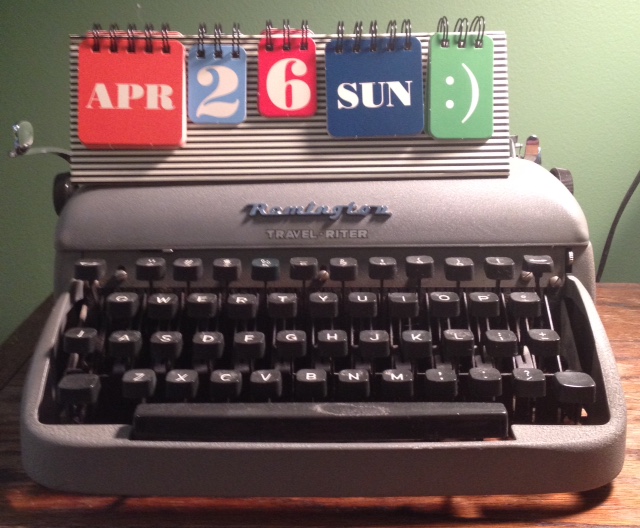
One moment can change everything.
A door is opened, a volcano erupts.
A door is closed, I am entombed.
Fearfully or gallantly we rise and act.
We do our best until the shockwaves dissipate.
Shakily we emerge to survey the damage.
The one spared may rejoice and thank God.
The one devastated may rail,
“My God, my God, why have you forsaken me?”
Both experienced tragedy and shudder.
Each is intertwined, each is forever altered.
What reservoir can contain the icy passion
that will not soon melt or evaporate?
Can flowers emerge from hardened lava?
Martha said, “Lord if you had been here my brother would not have died.” The flow of her heart is toward despair, but Jesus is pushing against that flow. He’s rebuking her doubt and giving her hope.
Mary says exactly the same thing, “Lord if you had been here my brother would not have died” . . . but instead of pushing against the flow of her heart’s sadness, he bursts into tears.
“Where have you laid him?” Jesus asked. “Come and see, Lord,” they replied. Jesus wept. Then the Jews said, “See how he loved him!” John 11:17-36
“Now frankly, everybody needs a ministry of truth and a ministry of tears . . . [Jesus] is the truth itself come in tears . . . You would think if a person were really divine, he wouldn’t be that emotionally exposed, but he is.”
[Excerpted from Timothy Keller, Encounters with Jesus, (“The Grieving Sisters” pp. 43, 51).



Click here to learn more about a new page on The Ebenezer Project:
home footprints kairos rhythms why

[download and print the pdf below]

Hi Elaine, At Carolyn’s house there is a large box of family photos. Susan, Ellen, and I all care about them, but none of us is really interested in being the caretaker of them. Would you like to take on that duty? If so, we will gladly package and ship them to you . . . what do you think? Love you, Beth
Until last November, my family had nine first cousins, seven girls and two boys, dotting the map from Utah to Florida. Through a tragic car accident, cousin Carolyn abruptly left her three sisters, two step-sons and a host of nieces, a nephew, step-grands, relatives and friends.
Faith helps. Time helps. But nothing can replace the loved one we have lost. Lost is an common word we use when someone dies. Yes, I will be the keeper. Send me the box.
“How many people have been born, lived rich loving lives, laughed and wept, been part of creation and are now forgotten, unremembered by anybody walking on earth today?” wondered Madeleine L’Engle as her mother was slipping away because of dementia.
Throughout our lives we gather, save and curate a variety of objects that are useful or enjoyable or meaningful to us. And into our households most of us assimilate a hodge podge of family items that have been christened heirlooms. Becoming the keeper of the possessions of our forbears helps keep our heritage alive.
heir + loom (Middle English)
heir = ‘heres’ (as in heredity), something passed down
loom = from ‘lome’ or ‘allame’, a weaving tool , a farm implement, to take shape or the finished product after a gradual process
My mother is still living but we are gradually losing her because of Alzheimer’s Disease. Together we have sorted through almost every object, photograph and letter, but now only my sisters and I can verify that the cloth doll she played with was named “Reagan”.
We three have the fullest memory of our mother among anyone still living, yet it is fragmentary. Who will tell her stories now? Who will be the keeper of mine?
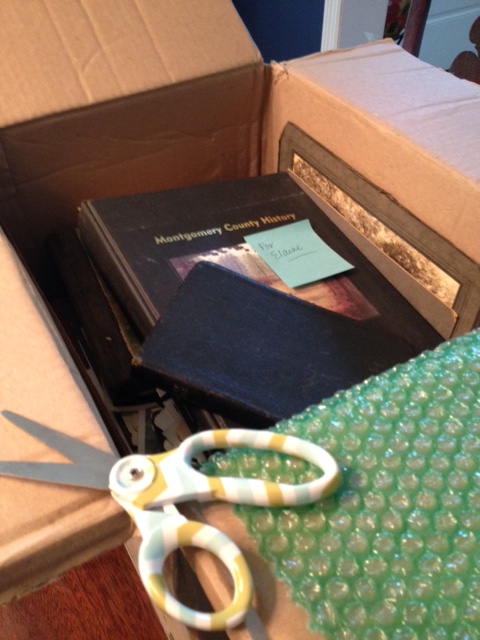

“I would like to believe that the Creator still remembers all of my mother, knows and cares for the [essence] of her and is still teaching her and helping her to grow into the self he created her to be, her integrated redeemed self.”
Madeleine L’Engle, Summer of the Great-Grandmother, p. 233

My creative life has been shaped by a number of writers and musicians and painters that I will never match in talent or achievement. One of my literary kindred hearts is Madeleine L’Engle.
I read her works of fiction as a pre-teen, then a parent, and finally began exploring her non-fiction work through Walking on Water: Reflections on Faith and Art.
Her words spoke to me during a time when I was ready to give up on writing . After only moderate commercial interest in my magazine articles, columns, study booklets or my first (and only to date) trade book, I was not embracing the “near-miss” as Sarah Lewis calls the pursuit of mastery over success.
My first thought of becoming a writer was planted by my second grade teacher, who began sending my compositions home with notes about my artistic potential. Starting in third grade, my piano teacher/choir director began echoing those affirmations, continuing to encourage me through high school and college. (I will return to them in a future post).
I have kept several childhood writings for half a century, because I feel they reflect my truest, unedited self. Last summer I received some of my dad’s personal files that my sisters thought I might want . I was astounded that my dad saved it, since no one person discouraged me more about the vocation of journalism.

My Father
My father is good humored, sweet and proud of his work. He’s black-headed with blue eyes, glasses and a sweet touch of curiosity. That’s why I have faith and love in him. There’s nothing but love in his heart.
Madeleine L’Engle’s The Crosswicks Journals I-V were published between 1972 and 1989. They probably mean more to me because they capture the volatile season of cultural, political and theological changes as I was coming to faith and coming of age. But they also encourage me to continue living life fully.
Madeleine was “my age” now, looking back on her marriage, her family life and her arduous creative journey. “To be half a century plus is wonderfully exciting” she wrote, “because I haven’t left any of my past and I’m free to stand on the rock of all that the past has taught me as I look towards the future.” (Circle of Quiet, p. 106).
After ten years of rejection slips (including A Wrinkle in Time), even her husband began questioning if she should put herself in the same company of great writers like Dostoevsky or painters like Van Gogh (who sold exactly one painting during his lifetime).
She pushed back, “It has nothing to do with comparing degrees of talent and everything to do with a way of looking at the universe . . . Dostoevsky is a giant; I look up to him; I sit at his feet; perhaps I will be able to learn something from him, but we do face the same direction no matter how great his stride, how small mine.“
Thank God for giants like Madeleine L’ Engle, Mrs. Rector and Mrs. Warren.

Thirty five years ago, I was a guest in the home of a lady whose den had a lovely, low table with a giant bowl of buttons in the center. I’m a toucher so I welcomed her invitation to dip my hands into that delicious assortment of textures, shapes and colors. Her grandparents had owned one of the historic American button manufacturing companies, so the bowl of generations-old buttons was a symbole for her family.
Several years later, my mother was culling through her three-legged sewing notions bucket and I spied a big plastic box of old buttons. “Where did those come from?” I exclaimed, as the memory of the giant button bowl rushed over me.
“I’m not sure why I’ve kept them all these years” she admitted. “Some are from little dresses you girls wore, some were on my old formals or sweaters, and these came off of one of Honey’s coats (her mother) that I loved . . . here are some buttons off of Daddy’s Navy pea coat.” It turned out that there were even buttons of Grandmother Curry’s (my great grandmother), who had given her the vintage wooden cabinet.
I boldly asked if I could have them, and whisked them away before she could change her mind! As soon as I returned home, I began gathering up the buttons in my sewing kit. I realized that I had quite a collection myself, between extra or lost buttons and a brief season of sewing children’s clothes and a few other ill-conceived projects.
I certainly didn’t have enough buttons to fill a large wooden bowl, but I found a smaller bowl that captured the character of what my mind had been incubating.
My button bowl contains tangible artifacts of the everyday lives of five generations. They were once attached to the clothing that covered those souls who came before me and shaped who I am today.
My young friend, Anna, was one of the first who recognized the wonder of the button bowl. She was barely three, yet carefully picked up each button, and examined it with a magnifying glass, then began sorting them by color or texture or material.
Over a dozen years, I have observed a variety of button rituals, mostly by children, a few curious adults and my grandson who still occasionally holds the spyglass against his magnified eye while asking the origin of a “family button”.
The button bowl has become another everyday ebenezer, a symbole of God’s faithfulness in very ordinary, daily ways. These are the ones I’m most prone to overlook.
[Listen here: http://congregationalsongs.com/downloads/fill-thou-my-life/]
Fill Thou my life, O Lord, my God,
In every part with praise,
That my whole being may proclaim
Thy being and Thy ways.
Not for the lip of praise alone,
Nor e’en the praising heart,
I ask, but for a life made up
Of praise in every part.
Praise in the common things of life,
Its goings out and in,
Praise in each duty and each deed,
However small and mean.
Fill every part of me with praise;
Let all my being speak
Of Thee and of Thy love, O Lord,
Poor though I be, and weak.
So shalt Thou, Lord, from me, e’en me
Receive the glory due,
And so shall I begin on earth
The song forever new.
So shall no part of day or night
From sacredness be free:
But all my life, in every step,
Be fellowship with Thee.
Words by Horatius Bonar (1866). Music by Jeff Bourque. Copyright 2004 Universal Music/Cumberland Belle Music.


I first heard of art historian Sarah Lewis through her TED Talk “Pursuit of Mastery.” Her CAT that day was (cause the audience to) embrace the near-win. That phrase strongly resonated with me and made me remember my first trophy–my only trophy–in a lifetime of near-wins.
Lewis pointed out that success is just “an event, a moment in time and a label that the world confers upon you” . . . what we continue to celebrate is creativity and mastery, “pursuing a kind of excellence in obscurity.” Mastery is not the same as excellence or success. It is not a commitment to a goal but a constant pursuit.
I was so struck by that eleven minute talk that I got some chalk and wrote mastery: excellence in obscurity on my desk (made from a reclaimed church door with chalkboard paint panels on the desktop).
Next I went digging around for that old softball trophy and placed it right where my eye will catch it everyday. I went on to read Lewis’ book The Rise: Creativity, the Gift of Failure, and the Search for Mastery, which impresses the importance of grit and creative practice. The near-win, she writes, changes our focus to consider how we plan to attain what lies in our sights but out of reach. Failure is not the outcome but the refused attempt.

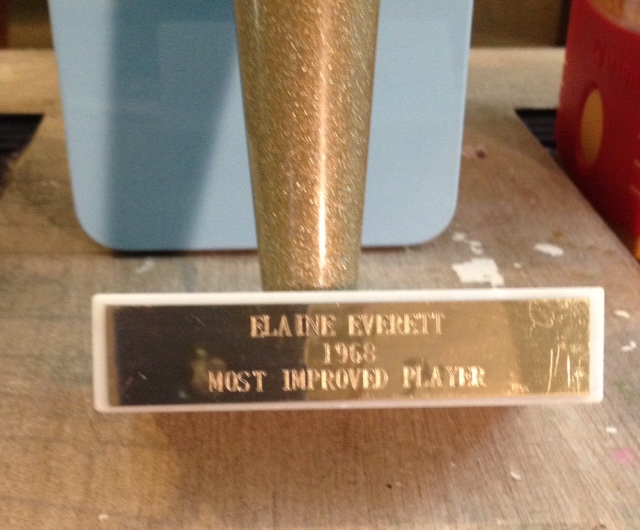
 Elaine Everett 1968 “Most Improved Player”
“All those who do more than compete, who strive for mastery, play on a field that exists largely within.” Sarah Lewis
[April 21, 2014 Ted Talk, https://www.ted.com/talks/sarah_lewis_embrace_the_near_win?language=en]

Children are naturally curious and imaginative, especially when invited to play, experiment and discover. Adults have difficulty retaining a child-like wonder that doesn’t care what others think about what they are currently interested in.
Sir Ken Robinson defines creativity as “original ideas that have value,” but cautions that we won’t come up with anything original if we aren’t prepared to be wrong. Perhaps this one fact explains why most adults do not become more creative. “We are educated” he said, “to become good workers not creative thinkers.”
I’ve always been a curious person, even a wonk in areas that interest (and sometimes obsess) me. Curious people carefully attend to the intriguing, unusual and remarkable events transpiring around them. They believe that every moment is ripe with opportunity! Ultimately, curiosity is chasing a moment of interest and turning it into a moment of understanding.
Resourcefulness, ingenuity and creativity require us to adopt a rhythm–a practical and powerful rule of life–that makes a space to explore and experiment and contemplate and dream in all directions . . . behind you, before you and beyond you.
P.S. I hear that little voice arguing “I don’t have time!” Someone once told me that you’ll never find time–you have to make time.
“Life is not made of the dreams we dream but the choices we make.” Joseph Stowell

English contains three moods: 1) the indicative (factual) 2) the imperative (commands) and 3) the subjunctive (non-factual).
The indicative mood states “I am writing a book.” The imperative directs “Please write a compelling book.” The subjunctive envisions “I might write a book about elves.”
Vietnamese does not possess the subjunctive mood, only the fact of what is or what was. A language with no words for regret or what ifs from the past may sound good at first . . . but without the subjunctive mood, we would also lack the words to imagine what could be or what should be in the future.
Living in the past will not make us more resilient, but reflecting on the past–what might have been or what should have been–comes along with the ability to ponder what could be or what will be in the future.
If we want to discover how the world could be different or better tomorrow, we must include the stories of our past experiences. In To Be Told, Dan Allender describes how to read your life as God has written it and challenges you to begin forging perspective by learning a better way to read your “tragedies”.
He says that our past was given, was written for us by the “odd hand of God” before we were born (Psalm 139:16); yet mysteriously, my future is yet unnamed and “I am frighteningly free to write as I desire because God has written me to be fully responsible for my story.”
[This post was inspired after hearing the Ted Talk “Grammar, Identity and the Dark Side of the Subjunctive” during the reading of To Be Told.
https://www.google.com/webhp?sourceid=chrome-instant&rlz=1C1ASUT_enUS516US516&ion=1&espv=2&ie=UTF-8#q=ted%20talk%20the%20subjunctive]
 everyday ebenezers